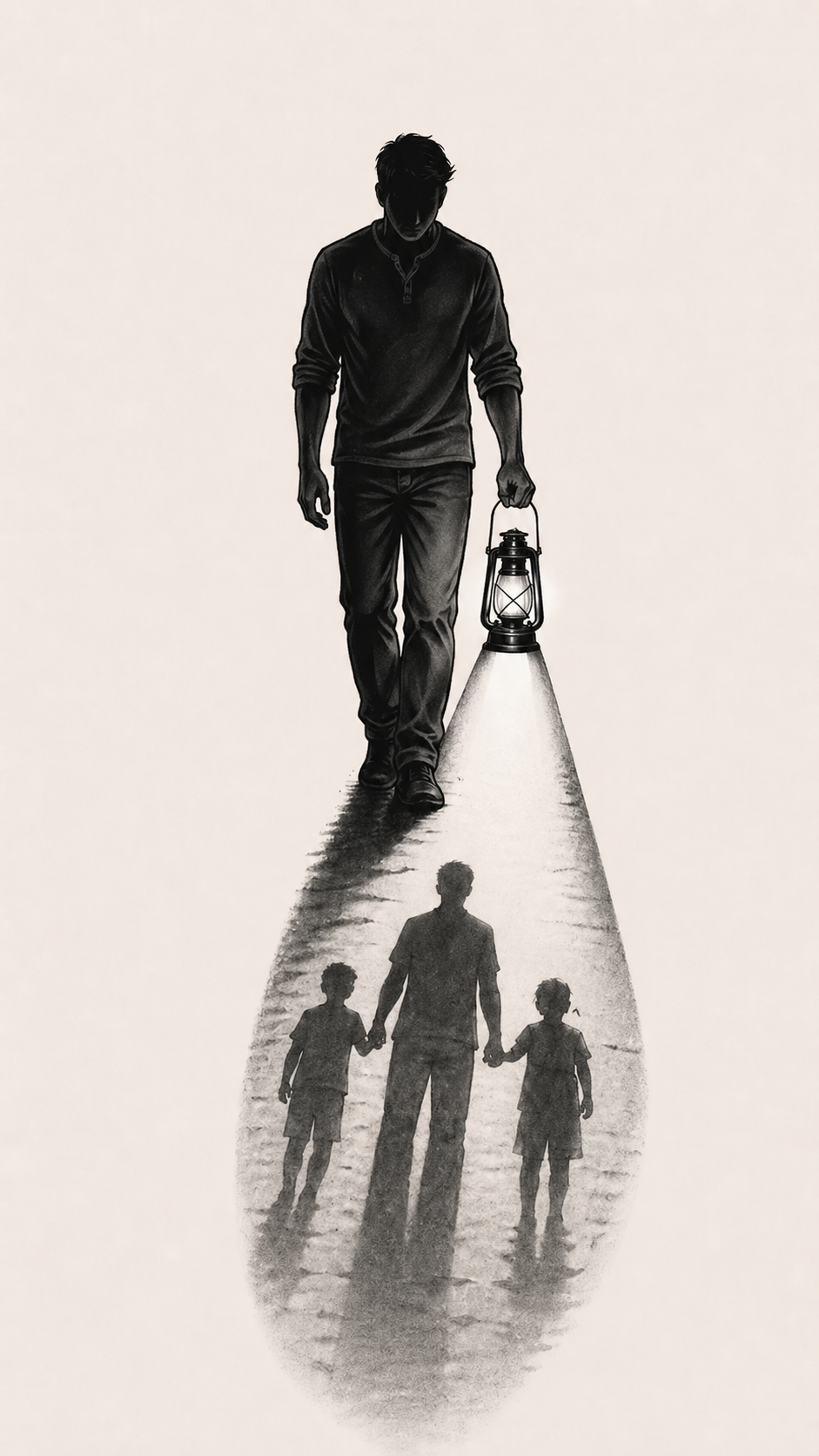
Book I, Chapter 1: No School, No Studio

The house was still standing.
That was the problem.
When a house burns down, people understand what happened. When it keeps standing—with dishes in the sink, the boys’ shoes by the door, my wife upstairs on a work call, and me holding my phone like it might tell me how to stay alive—everyone can pretend there is still a home inside it.
For a while, there was.
Or at least there was enough of one for me to keep being their father.
Back then, we were still in the house in Reading.
The boys were still there. Their stuff was still there. Their cereal bowls, school papers, toys, socks, jackets, shoes, crumbs, arguments, and impossible little-boy energy still filled the place. I still had a kitchen to stand in and a door to lock at night. I still had a basement. I still had a marriage, technically. I still had a version of fatherhood that happened in real time, in the same rooms where they were making noise.
But underneath it, something had already started to go wrong.
I could feel it before I could explain it. My nervous system had started acting like the house was on fire even when nothing obvious was burning. I could still make lunch. I could still answer questions. I could still get the boys outside and keep them from killing each other over some plastic thing neither of them had cared about five minutes earlier.
But inside, I was beginning to come apart.
The first visible crack was work.
I couldn’t take the deadening grind of regulatory work anymore. My last job was as consultant number two at a one-man consulting company in Vermont—the other man being the “CEO”—though I worked remotely from the house where my wife and I were still living.
I got fired.
I never told her.
I told her there wasn’t enough work and that I had been laid off, and she seemed to buy it. Maybe she did. Maybe she did not. By then, our marriage had already developed that wonderful domestic feature where two people can live in the same house and still not be having the same conversation.
That was when I came up with what I thought was a brilliant plan for what came next.
As a guitar and bass player, I had spent plenty of time screwing around with recording, mixing, and home-studio gear, which, in my mind, apparently qualified me to launch a business out of the basement.
The only problem was that there was no studio in the basement, no clients, no income plan worth the name, and I had to somehow get the idea past my brick wall of a wife.
My sister-in-law’s husband, Anthony, lived nearby in Wakefield. He was a civil engineer and liked building things, so I ran the idea past him. He told me that if I paid for the materials, he would build it.
He wanted to do some work around his own house too and apparently needed proof for his wife that he was capable of it.
Fair enough.
We were all running our own little domestic grant programs.
The harder part was selling the idea at home. Boston-area living was expensive as hell, and even though my wife and I both made decent money when I was actually employed, things were still tight. By then, she controlled the budget, which meant I had to bring her a plan that looked less like a midlife panic project and more like an investment.
I priced out the materials for a not-great but workable basement studio, ran the numbers on the gear I thought I would need, and brought the whole thing to her carefully, waiting until she was in as good a mood as I was likely to get.
Her first response was the crossed arms and the face.
“Absolutely not. No way.”
Then I told her how badly I was struggling in the biopharmaceutical world, which by that point should have been obvious from my work history alone—multiple jobs, some of them not even lasting a year. I was not exactly building a career. I was collecting exits.
She gave me a dirty look and said, “Let me look at the budget.”
That was how things worked by then. She controlled the money, and I brought ideas to her like a man petitioning a hostile zoning board.
When she came back, she said, “Okay, we can do it, but the nanny has to go. You’ll do school pickup and watch the boys afterward, and we are absolutely not taking out a small-business loan for your gear. You’ll have to find another way to pay for that.”
There it was.
Permission, with teeth.
Once I got the green light, I texted Anthony and told him it was a go.
“Great,” he wrote back. “When do we start?”
“As soon as possible,” I said.
He looked over my materials budget, and it was close enough, so I cleared out the part of the basement we would need and gave him the first installment for supplies. After that, I sold off extra guitars, pedals, and amps until I had enough money to piece together a bare-bones setup.
Not what I wanted.
Enough to get started.
Once construction finally finished, we let the nanny go, and I took over pickup and after-school duty with the boys.
Then I got to work trying to figure out how exactly this studio was supposed to make money.
Mixing was really my stronger suit, so I decided to start there. The plan was to find up-and-coming artists I thought might actually have a shot and offer to mix for a percentage of sales. That idea did not work out the way I hoped, but I did find a very good singer and guitarist from Brazil who was willing to work with me.
Money was money.
I did not care whether it came from Brazil or the U.S.
For a little while, things looked almost plausible. The producer on my band’s album—who was pretty accomplished—was even mentoring me a little. I had a basement studio, a handful of gear, one paying client, and just enough delusion to mistake motion for traction.
Then COVID hit the news.
Knowing biology as well as I did, I warned my bandmates, “This is going to be bad. This is going to be really bad.”
They laughed it off.
Later, when the pandemic was in full force, our drummer sent a group text that said, “Remember when Scott told us this was going to be bad and we all laughed at him?”
That was pretty much it for Freeman Sound Works.
The studio shut down almost as soon as it started. There was no school, no normal schedule, no realistic way to build a business from the basement while two young, adventurous boys needed a whole day’s worth of attention and my wife worked from home upstairs in our bedroom.
She came down only when she absolutely had to.
So the business died.
But something else happened.
I became the one on the ground with them.
From the time the boys woke up until she finally logged off later that night, they were with me. I made the meals, took them outside, kept them from wrecking the house or injuring themselves, and tried to keep two young, adventurous boys entertained through days that had suddenly lost all normal structure.
I moved from one thing to the next like some kind of cruise director with no ship, no staff, and no port in sight, while my wife—despite being only upstairs—did next to nothing to help as long as she was “working.”
It is not that I did not enjoy the hell out of more time with my sons.
I did.
I loved being with them. I loved the little jokes, the noise, the insane kid logic, the way a normal Tuesday could become a full expedition because somebody found a stick, a bug, or a rock with unusual properties. I loved making food for them. I loved being the one they came to when they needed something. I loved that fatherhood was not an idea in my life.
It was a room I stood in.
But it was taxing as fuck.
And my mind was no longer normal.
COVID had turned the house into a bad multi-use facility: office, school, psych holding pen, marriage courtroom, boys’ clubhouse, and failed recording studio, all packed inside the same walls. The boys still needed breakfast. They still needed lunch. They still needed someone to say no before they launched themselves off the furniture like small drunk paratroopers.
That was the part nobody wrote into the treatment plan.
Then George Floyd was murdered.
The news was everywhere.
There was no escaping it. Not really. It was on television. It was on phones. It was on social media. It was in every conversation people were having and every conversation they were avoiding. His death was not some distant national event my mind could file away under terrible things happening somewhere else.
It found something in me.
When I was twenty years old, I had my own experience with police brutality. I had buried it so completely that I did not even understand it as buried.
That is the trick of certain memories.
They don’t always feel hidden.
Sometimes they just feel gone.
Until they are not.
I did not sit down calmly and remember it like a story. It came back like a break-in. One minute I was a father in a house during a pandemic, trying to keep two boys occupied and fed, and the next my body was somewhere else entirely.
Same skin, different year.
Same lungs, different air.
That memory had been locked away for years.
The lock failed.
It was George Floyd’s murder, and the way the whole country kept replaying the evidence, that tore open something I had not known was still sealed inside me.
And there I was, watching the boys during the day in that state.
I would make them food while my nervous system was screaming. I would stand at the counter spreading peanut butter or cutting fruit while my body acted like danger was standing three feet behind me. I would hear one of them yell from another room and jump like I had been struck. I would try to answer them in a normal voice because they did not need a father who sounded like a live wire.
They needed lunch.
They needed help finding the thing they had just put down.
They needed me to break up the argument, open the package, wipe the spill, fix the toy, explain why they could not do something obviously dangerous, and act like the whole world had not come loose from the wall.
My wife was upstairs working.
I was downstairs trying not to fall apart in front of them.
That was the arrangement.
The house was quiet at night.
The boys were asleep.
My wife was upstairs.
Everything looked normal enough from the outside, which was part of the cruelty. If somebody had driven past the house, they would have seen nothing. Just another Reading home with the lights mostly off. A family inside. A father awake too late. Maybe someone working. Maybe someone worrying about the pandemic like everyone else.
They would not have seen what George Floyd’s murder had pulled back into my body.
They would not have seen the boys’ father trying to stay calm enough to make breakfast in the morning.
They would have seen the house.
Still standing.
